AI Rollout Change Management: A Practical SME Guide
Discover how mid-sized businesses in Vietnam and the Philippines can overcome employee resistance and secure real ROI using a structured AI change management process.
Most failed technology initiatives in mid-sized businesses do not collapse because the software failed its technical evaluation. They stall because the people expected to use the software quietly reject it. In high-growth markets like Vietnam and the Philippines, business owners frequently invest in generative tools, predictive models, or automated processing systems only to find team members reverting to legacy spreadsheets weeks later. Without structured ai rollout change management, even the most capable artificial intelligence tooling becomes an expensive operational distraction rather than a competitive advantage.
Successfully modernizing day-to-day operations requires treating behavioral shifts with the exact same rigor applied to software architecture and vendor selection.
Why AI Implementations Stall in Mid-Sized Organizations
Mid-sized companies face a distinct set of operational dynamics during technology transformations. Unlike multinational corporations, SMEs rarely maintain dedicated change management units. Unlike agile startups, they operate with entrenched workflows, tenured staff, and tight cross-departmental dependencies.
When leadership introduces machine learning or workflow automation without prior alignment, employees experience predictable friction points:
- Silent Fear of Redundancy: Staff members assume automated drafting, automated reconciliation, or predictive customer routing exists to eliminate their positions.
- Middle Management Skepticism: Department heads and team leads often perceive automated decision-support systems as a challenge to their hard-earned operational authority.
- Fragmented Onboarding: One-off training sessions demonstrate software features rather than integrating the output directly into the employee's existing daily routine.
- Loss of Psychological Safety: Workers worry about being penalized if an algorithmic tool generates an error on their watch, so they revert to manual methods to protect themselves.
Overcoming these hurdles requires stepping away from top-down mandates and building an environment where teams understand how automated systems elevate their core responsibilities.
A Strategic AI Rollout Change Management Framework
To move from passive skepticism to sustained user adoption, leadership must approach operational transitions systematically. The following four-stage framework helps business operators guide internal teams through software shifts without disrupting baseline productivity.
1. Transparent Context and Role Definition
Change begins with early transparency. Business leaders must address job security concerns before the first software license is distributed. Clarify precisely why the business is modernizing, how work output will be measured, and how productivity dividends will be reinvested into business growth rather than headcount reduction.
2. Departmental Champion Identification
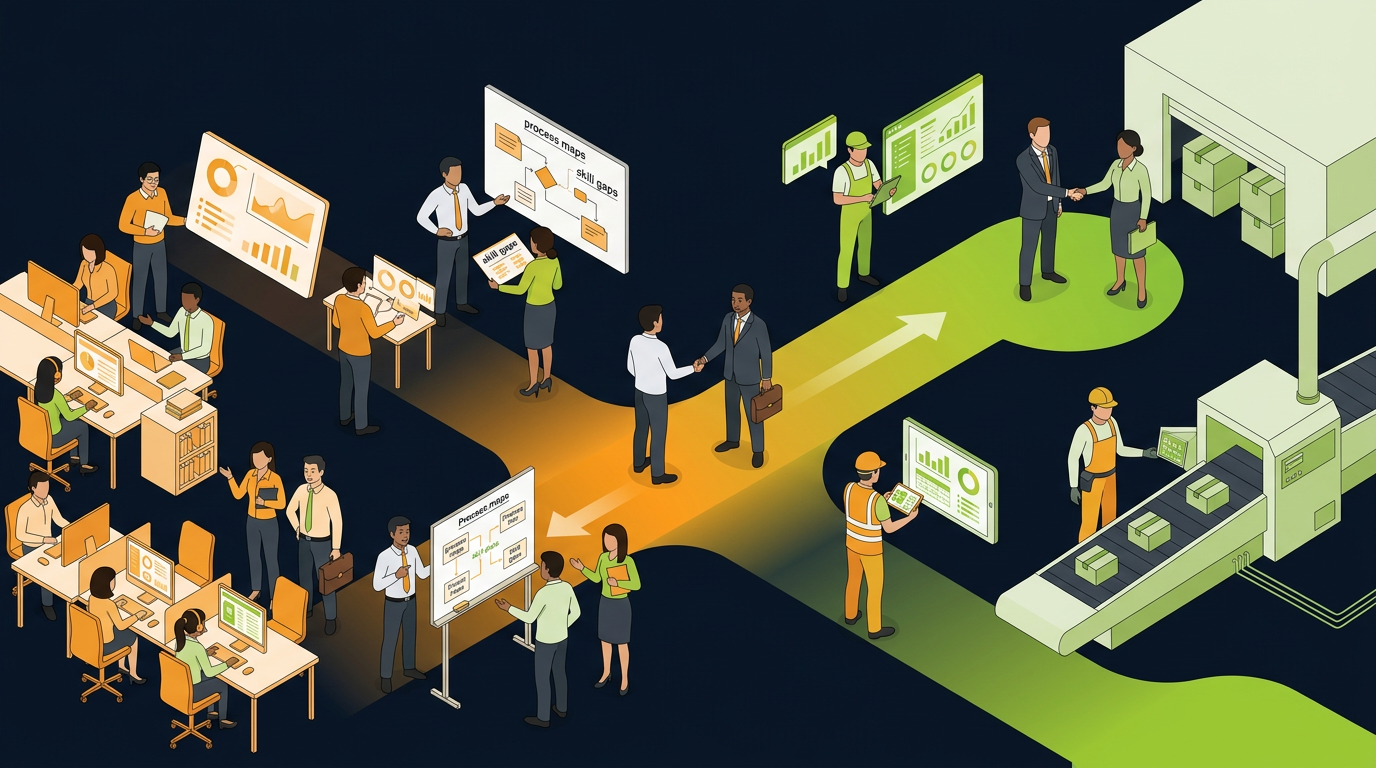
Do not rely entirely on internal IT personnel or external technical consultants to persuade your operational staff. Identify informal leaders within customer support, sales, accounting, and supply chain teams who demonstrate high process curiosity. Equip these internal champions early, allow them to pressure-test the workflows, and let them demonstrate tangible time savings directly to their immediate peers.
3. Phased Workflow Redesign
Attempting a blanket transition across entire business units simultaneously invites confusion. Isolate single, non-critical sub-processes first. For example, rather than automating client-facing communication outright, integrate generative summarization into internal case documentation. Once the team builds confidence in data accuracy, expand scope incrementally.
4. Continuous Operational Feedback Loops
Establish fixed bi-weekly operational checkpoints between technical administrators and daily end-users. Give operators a straightforward channel to report hallucinations, edge-case discrepancies, or cumbersome user interfaces. When employees see their feedback actively improving the tools they rely on, psychological ownership shifts from executive management to the operators themselves.
Navigating Cultural Nuances in Southeast Asia
Managing organizational change in Southeast Asia requires acute sensitivity to workplace communication norms. In both Vietnamese and Philippine enterprise cultures, direct confrontation is frequently avoided. Frontline staff are often hesitant to voice confusion or point out system limitations to executive leadership during open company meetings.
To address these dynamics constructively, implement specific operational habits:
- Conduct Small-Group Feedback Sessions: Replace company-wide reviews with informal, 4-person working sessions led by local team leads to encourage frank assessments.
- Reward Early Failure Reporting: Publicly acknowledge team members who discover system edge cases or prompt inaccuracies during initial rollouts, framing these discoveries as institutional improvements.
- Localize Operational Documentation: Provide standard operating procedures and internal prompt libraries in both English and local business languages (such as Tagalog or Vietnamese) to eliminate nuance barriers.
- Align Key Performance Indicators: Update employee scorecards to evaluate process adherence and creative problem-solving using new systems, rather than strictly measuring raw output volume.
Measuring Adoption Beyond Software Logins
Software administrative dashboards routinely track daily active users and seat utilization, but login volume is a poor proxy for genuine transformation. A user might open a platform simply to satisfy management expectations while executing the actual work manually elsewhere.
True adoption appears in operational velocity and quality metrics. Look for measurable reductions in cycle times for routine deliverables, lower back-office error rates, and staff-initiated workflow recommendations. When team members begin proposing novel operational use cases on their own initiative, organizational change has successfully rooted.
Sustainable digital transition is ultimately an exercise in human alignment. By committing to disciplined ai rollout change management, business operators can remove fear, elevate frontline capabilities, and turn modern computational tools into durable enterprise value.
FAQ
How long should an AI change management plan take for an SME?
For a company with 30 to 200 employees, an initial change management cycle typically spans 8 to 12 weeks. This includes 2 weeks of stakeholder alignment, 4 weeks of targeted pilot testing with internal champions, and 4 to 6 weeks of monitored departmental onboarding.
How do we handle staff who refuse to adopt new automated workflows?
Avoid immediate punitive measures. Investigate the root cause through one-on-one sessions with their team lead. Resistance usually stems from a lack of confidence with technical tools or unaddressed fears regarding performance evaluations. Pair resistant workers with enthusiastic departmental peers for hands-on, practical execution.
Should AI usage policies be formalized in employee handbooks?
Yes. Clear acceptable-use policies protect company intellectual property and set explicit boundaries around data confidentiality, algorithmic oversight, and output verification. Formal documentation removes ambiguity, giving employees confidence about what is permitted.
Contact LIMONCG at /contact to build a tailored transition roadmap that aligns your teams, processes, and technology investments for sustainable growth.

