
AI Project Pricing: Fixed vs. Time & Materials for SEA SMEs
Navigating AI project costs can be complex. This guide breaks down Fixed-Price and Time & Materials models, helping SMEs in Southeast Asia choose the right approach for successful AI adoption and digital transformation.
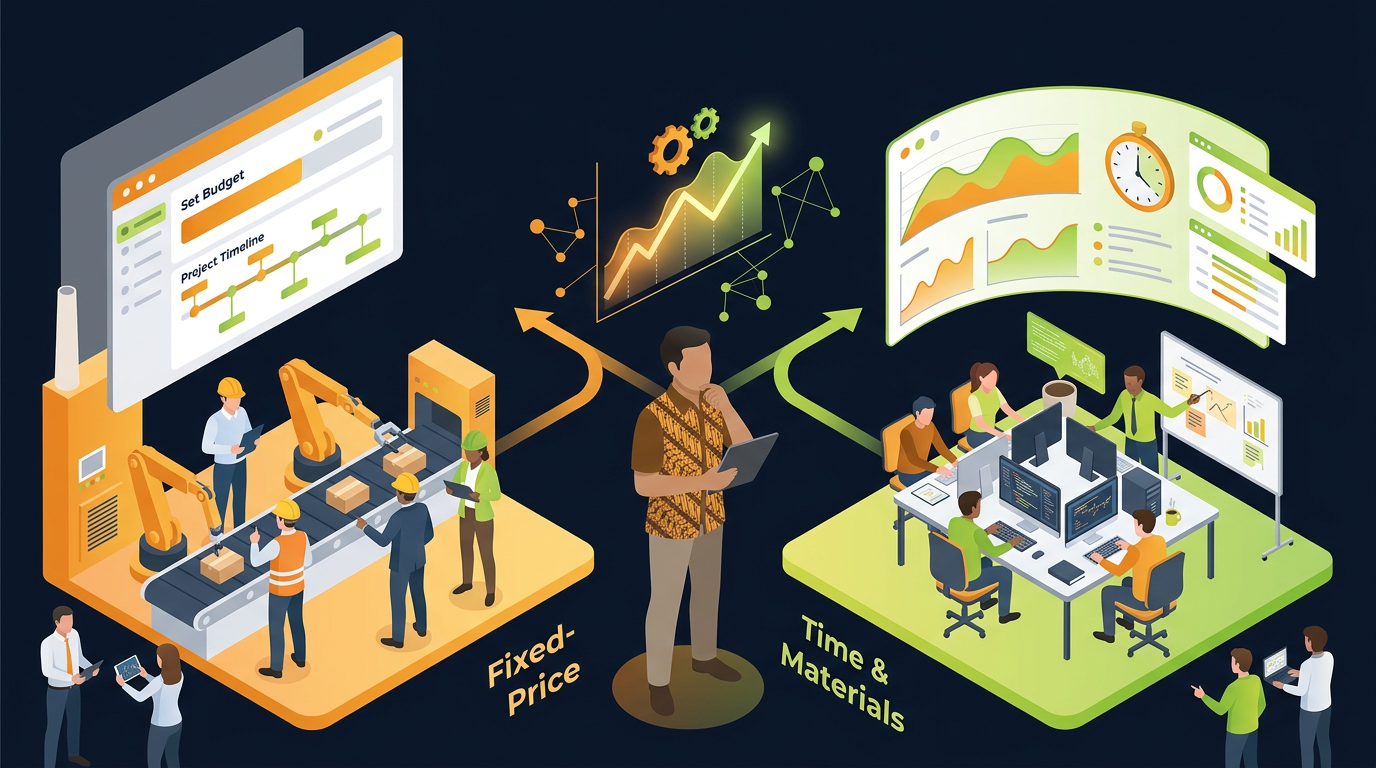
Investing in AI can be a game-changer for small and medium-sized enterprises (SMEs) in Southeast Asia, driving efficiency, innovation, and competitive advantage. However, one of the most critical decisions businesses face is how to structure the financial agreement for these complex projects. Understanding AI project pricing models – specifically Fixed-Price versus Time & Materials (T&M) – is crucial for managing expectations, controlling costs, and ensuring project success.
The Challenge of Pricing AI Projects
Unlike traditional IT projects, AI implementations often involve a higher degree of research, iteration, and unforeseen challenges. Data quality, algorithm performance, and integration complexities can introduce variables that make upfront estimation difficult. This inherent uncertainty is why the choice of pricing model is not just a financial decision, but a strategic one that impacts project flexibility, risk management, and ultimately, ROI.
Fixed-Price AI Projects: Predictability with Trade-offs
In a Fixed-Price model, the client and the consulting firm agree on a set scope of work and a single, predetermined cost for the entire project. This approach offers budget certainty, which is highly attractive to many SMEs.
When Fixed-Price Works Best
- Well-defined Scope: Ideal for projects where requirements are clear, data sources are understood, and outcomes are precisely measurable. Examples include automating a specific, repetitive back-office task with established data inputs, or deploying an off-the-shelf AI solution with minimal customization.
- Limited Budget Flexibility: If your SME has strict budgetary constraints and needs absolute cost predictability, a Fixed-Price contract can provide peace of mind.
- Lower Risk Tolerance: For businesses that prefer to offload cost overrun risks to the consulting firm, this model is appealing.
Advantages of Fixed-Price
- Budget Predictability: You know the total cost upfront, simplifying financial planning.
- Clear Deliverables: The scope is meticulously defined, ensuring both parties understand what will be delivered.
- Reduced Client Oversight: Less day-to-day management is required once the scope is agreed upon.
Disadvantages of Fixed-Price
- Lack of Flexibility: Any changes to the scope (e.g., new features, altered requirements, unexpected data issues) typically lead to change orders, increasing costs and extending timelines.
- Potential for Underestimation: If the complexity is underestimated, the quality of work might suffer as the vendor tries to stay within budget, or the vendor may push for costly change orders.
- Slower Iteration: The rigid nature can hinder agile development, which is often beneficial for AI projects requiring experimentation.
- Less Collaboration: Can sometimes foster an 'us vs. them' dynamic, as the focus shifts to adhering strictly to the contract rather than collaborative problem-solving.
Time & Materials (T&M) AI Projects: Flexibility for Evolving Needs
Under a T&M model, the client pays for the actual hours worked by the consulting team and the cost of any materials used. This model offers greater flexibility, making it suitable for projects with evolving requirements or significant R&D components.
When T&M Works Best
- Evolving Requirements: Perfect for exploratory AI projects, proof-of-concept development, or scenarios where the full scope isn't clear at the outset. Think of developing a novel recommendation engine or an advanced predictive analytics model where initial experimentation is needed.
- High Innovation/R&D Component: When the project involves significant research, experimentation, and iterative development to find the optimal solution.
- Adaptive Strategy: If your SME values the ability to pivot and refine the project direction based on early results or market feedback.
- Long-term Engagements: For ongoing AI initiatives that require continuous improvement and adaptation.
Advantages of Time & Materials
- Flexibility and Adaptability: Easily accommodate changes in scope, new discoveries, or shifts in business priorities without formal change orders.
- Higher Quality Output: The focus is on delivering the best possible solution, as the team isn't constrained by a fixed budget for a predefined scope.
- Greater Collaboration: Encourages closer partnership between client and vendor, fostering shared ownership and problem-solving.
- Faster Start: Less time spent on detailed upfront scope definition, allowing projects to commence quicker.
Disadvantages of Time & Materials
- Budget Uncertainty: The total cost is not known upfront, which can be a concern for budget-conscious SMEs.
- Requires Active Management: Clients need to be actively involved in monitoring progress and managing the scope to prevent costs from spiraling.
- Risk of Scope Creep: Without clear boundaries, projects can expand unintentionally, leading to higher-than-expected costs.
- Trust Dependence: Relies heavily on a trusting relationship with the vendor to ensure efficient use of time and resources.
Choosing the Right Model for Your SME's AI Project Pricing
The decision between Fixed-Price and T&M for your AI project pricing isn't about which model is inherently 'better,' but which is a better fit for your specific project, risk appetite, and relationship with your consulting partner.
Consider these factors:
- Project Clarity: How well-defined are your AI project requirements and desired outcomes?
- Budget Control vs. Flexibility: Do you prioritize strict budget adherence or the ability to adapt the project as it progresses?
- Risk Tolerance: How comfortable are you with potential cost fluctuations versus scope rigidity?
- Vendor Relationship: Do you have an established, trusting relationship with your consulting firm?
- Project Duration and Complexity: Is it a short, simple automation, or a complex, long-term AI strategy?
Hybrid Approaches
Sometimes, a hybrid model can offer the best of both worlds. For example, a Fixed-Price for an initial discovery or proof-of-concept phase, followed by a T&M arrangement for the full implementation once clarity is achieved. This balances early budget certainty with later flexibility.
Key Takeaways for SEA SMEs
- Define Your Goals: Clearly articulate what you want your AI project to achieve before discussing pricing models.
- Assess Project Uncertainty: Be realistic about how much you know (and don't know) about the project's data, technology, and integration needs.
- Communicate Openly: Engage in transparent discussions with your chosen AI consulting partner about their proposed approach and pricing rationale.
- Focus on Value: Ultimately, the goal is to achieve a strong ROI. The pricing model should support that, not hinder it.
FAQ
Q: Can I switch from Fixed-Price to T&M (or vice versa) mid-project?
A: While possible, it's generally complex and requires renegotiating the contract, potentially leading to delays and additional costs. It's best to choose the right model upfront.
Q: How do I ensure cost control with a T&M contract?
A: Establish clear communication channels, set regular review meetings, define budget caps, and ensure detailed time tracking and reporting from your vendor. Active project management from your side is crucial.
Q: Which model is more common for initial AI pilot projects?
A: T&M is often preferred for pilot projects, as they inherently involve exploration and learning. It allows for adjustments based on early findings without needing numerous change orders, making it ideal for validating AI project pricing for early-stage initiatives.
Choosing the right AI project pricing model is a critical step towards successful digital transformation for SMEs in Vietnam and the Philippines. By understanding the nuances of Fixed-Price and Time & Materials, you can make an informed decision that aligns with your business goals and ensures predictable, impactful AI adoption.
Ready to discuss your AI project and find the best pricing strategy? Contact LIMONCG today.

